Module 09 · Signature AR builds
Intelligent UI: 3D models from a spoken word
At the endA 3D model from a spoken word, and your honest bill
- Time
- about 52 min
- Level
- Advanced
- You need
- Unity 6 (6000.3 LTS used) with Meta XR SDK, MRUK, URP, glTFast and com.unity.webrtc · Python 3.11+ with separate virtual environments per GPU worker · Claude Code and/or Codex · adb (from Unity's Android tools)
- Before this
- Intelligent UI: live panels and an AI that sees your room · From image to 3D model · Memory and handovers across sessions, machines and agents · An NVIDIA GPU with 16 GB of VRAM for the local 3D chain (I used an RTX 5080), and 200 GB of free fast disk space
Evidence: documented practice with some reconstructed steps.
What this lesson covers
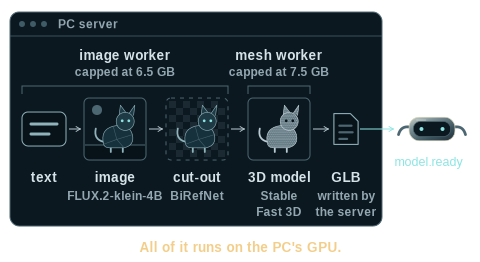
The second half of my Intelligent UI case study, a Quest app that has 3D models generated on your own PC from a spoken word. Two prompt cards, the measured latencies, where acceptance failed, the honest bill in tokens, hours and money, the handover between two agents and the storage you'll actually need.
- Steer a local text-to-3D chain (image, cut-out, single-image-to-3D, runtime import) by the numbers it should hit
- Budget the project honestly in tokens, hours, subscriptions, disk space and model licences
This lesson is part of full access
You can see above what it covers. The steps, prompts, code and downloads open with full access: all 46 lessons for €49, paid once.