Module 06 · Voice AI in mixed reality
Tools, scope and cost control
At the endVoice tools with a hard scope and a cost limit
- Time
- about 45 min
- Level
- Advanced
- You need
- Unity with Meta XR SDK · Claude Code or Codex · Your realtime proxy (PC bridge or Cloudflare Worker) · A spreadsheet for the cost sheet
- Before this
- Realtime voice architecture · A working voice connection with at least one tool (the Lumen exercise)
Evidence: documented practice with some reconstructed steps.
What this lesson covers
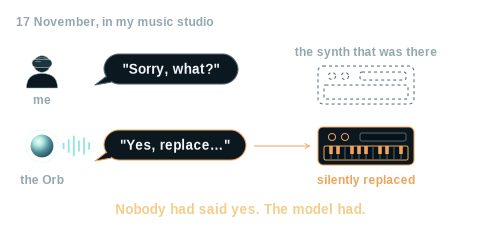
Why a voice model says "done" for features that don't exist and deletes things after "Sorry, what?", and the structure that stops it - small tools that mirror your buttons, a system prompt that lists what does not exist, code that only trusts the user's own "yes", every feature usable without voice, and hard money limits in layers. With the real costs per minute and what to tell your agent.
- Design small, verb-named tools that map one-to-one to your app's own buttons
- Write a system prompt with explicit negative scope so the model says "this app can't do that" instead of pretending
- Put deterministic code between a transcript and any destructive action
- Estimate voice cost per minute and set per-session, per-user, per-day and monthly limits
- Handle voice as personal data and disclose the AI voice honestly
This lesson is part of full access
You can see above what it covers. The steps, prompts, code and downloads open with full access: all 46 lessons for €49, paid once.